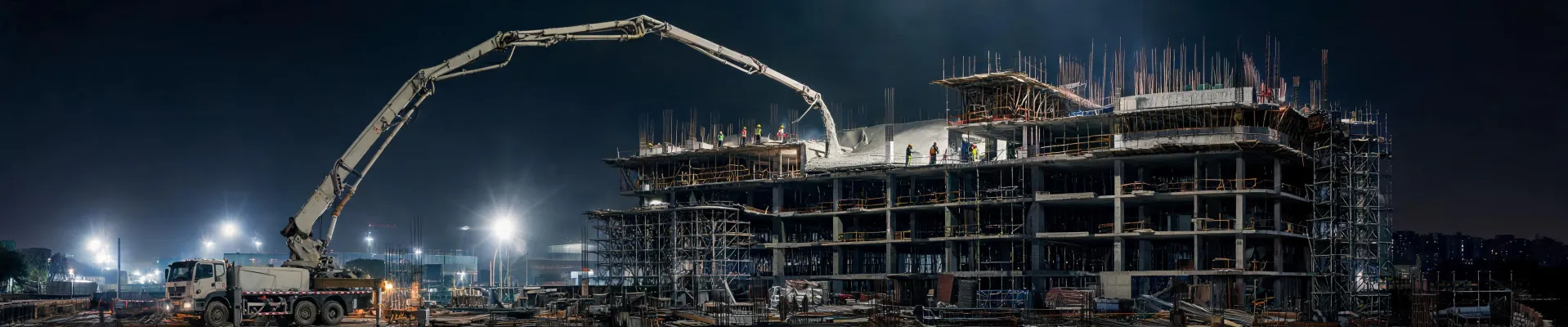
It was 7:40 on a Tuesday when our foreman called. The Schwing boom pump was down—40 minutes into a slab pour, the rock valve had seized. The "OEM equivalent" cartridge we'd installed the night before had not, as it turned out, been equivalent.
I'm the office administrator for a concrete contractor of about 30 people. We run a small fleet: two Schwing concrete pumps, a line pump, and an asphalt paver for parking lot and site work. All parts ordering goes through my desk—roughly $400,000 a year across ten vendors. I report to both operations and finance, which means I get to hear about every equipment problem from both sides.
When I took over purchasing in 2020, I figured this was basically a matching exercise. Part number goes in, part comes out, compare prices, done. I learned the hard way that two catalog entries with the same part number are not always the same part.
The problem starts with the phrase "OEM equivalent"
When a machine goes down, here's what I used to do: search for "Schwing concrete pump parts," open the first few listings, match the part number from our manual, compare prices. The pages all look professional. The part photos look right. The "OEM equivalent" badge appears everywhere—on a genuine component, on a private label component, and on a reverse-engineered copy that has never seen a factory quality check.
That search actually returns four kinds of catalogs: factory-authorized dealer parts books, aftermarket generalists, suppliers who reprint manufacturer part numbers in their own listings, and private label brands claiming equivalence to the original. The part number is the same. Where the part comes from, what it's made of, and how it was tested... the listing doesn't tell you that.
The asphalt paver catalog from one of our aftermarket suppliers was a perfect example. Everything in it was listed as "OEM equivalent." It looked legitimate. We found out later their "equivalents" had never been verified against the original manufacturer's specs for the model we run. Well, let me rephrase that. I can't prove they were never verified. What I can prove is that their documentation couldn't show any verification.
The part number matched. The revision didn't.
The part that failed was a rock valve cartridge for one of the Schwing concrete pumps. The aftermarket listing matched our part number. It matched the illustration in our manual. What it didn't match was the current revision.
Schwing had superseded that part number—the newer design uses a different bushing material to handle higher operating pressures. The aftermarket catalog still listed the old version as current. Or rather, they'd never updated their database, and their "equivalent" was built to the old spec.
The aftermarket cartridge cost about half of the genuine one. At the time, that felt like a no-brainer. It wasn't.
The pump seized. It cracked the swing tube bearing housing. The repair bill: a new cartridge, the housing repair, our mechanic's labor, plus the concrete that had to be chopped out and re-poured after the pump died mid-start. Just under $13,000 in direct costs. That doesn't include the two days of downtime, the general contractor's phone calls, or the crew that got sent home with partial pay.
I'm not an engineer, so I can't speak to the metallurgy of the rock valve or the pressure differentials involved. What I can tell you from a procurement perspective is that a part can bolt on perfectly and still be wrong in ways you can't see until it's under load.
The quieter cost: rework instead of breakdowns
The asphalt paver taught us the same lesson in a quieter form. We had a private label auger chain installed—the supplier's paperwork was excellent, the pricing was right, and the chain fit. But after a few weeks, it started wearing unevenly. The pins wore differently than the OEM chain we'd used before, and the paver began leaving shadows in the mat. Streaks in fresh asphalt. The GC noticed before we did.
That's a different kind of invoice. Tearing out and re-paving a section of a parking lot. Ordering the OEM chain anyway. Explaining the schedule slip. The asphalt paver OEM vs private label question is really a question of which parts are safe to cross over and which aren't—and no catalog listing will make that distinction for you.
The invoice nobody budgets for
When I've told this story to other buyers, almost everyone asks: did the supplier pay? The answer is no. Their terms said "compatible part," not "manufacturer equivalent." We accepted the replacement part, paid our mechanic, and ate the costs.
That's actually the wrong question. The question is how to verify a part before it goes into a machine, not after it fails.
The piece I really want to pass on: the price of the part is the smallest part of the cost when that part fails.
Think about what's in motion on a commercial pour: the ready-mix trucks, the pump operator, the crew, maybe a crane, an inspector, the concrete itself. Every one has a schedule and an hourly cost. A pump that goes down mid-pour creates a domino effect that rolls through the rest of the week. The worst season for this is summer—when everything is pouring and no one has spare machine time.
I can only speak to our situation. If you're running fifty pumps across three states, your numbers are bigger. The mechanics of the problem don't change.
OSHA's construction safety regulations treat concrete pumping equipment as a serious matter. I'm not a safety professional, so I won't go beyond that. But when you're buying a part that carries hydraulic pressure or lives in a wear path, you're buying an engineering decision, not just a piece of metal. The engineering decision you didn't pay for still has consequences.
What I do now
I'm not going to tell you "genuine parts only, always." That's too simple. We buy aftermarket hydraulic filters and grease without losing sleep. Some private label wear parts are honestly fine. But the category is too broad to be trusted blindly.
I changed two things.
First, I ask hard questions before ordering anything that touches hydraulic pressure or critical wear:
- Is this a genuine manufacturer part? Show me the documentation.
- If it's private label, who actually made it? Can I see their spec sheet?
- Can you confirm this part number matches the current revision for my machine's serial number?
- What's your responsibility if it fails in service?
Second, for anything critical on the Schwing pumps, I go through the authorized dealer network. Schwing has been building concrete pumps in Germany since the 1930s, and their parts system tracks revisions by serial number. That traceability only exists through factory channels. It's worth the price difference for components that can bring a machine down.
One more thing, about the human side. When our company was smaller, some suppliers wouldn't return our calls. A $200 order wasn't worth their time. The vendors who took that $200 order seriously are the ones we still use today—and now they get the bigger orders too. (Should mention: I've since recommended two of those vendors to contractors in other states who asked.)
Today's small order might be tomorrow's fleet purchase. The suppliers who treat every order like it matters are the ones who earn trust. And when it comes to our Schwing concrete pumps and that asphalt paver, trust is the thing I'm really buying.
Bottom line: OEM isn't only about the logo on the part. It's about traceability—knowing exactly what you're installing and what it was tested against. That's what the catalogs don't tell you, and it's why the price comparison is the wrong place to start.